
Ohio County Tax Record Fields
Each fact in a tax search comes from a system built for a different purpose. Before comparing any amounts, read the source, the assessment year, the payable year, and the parcel number together as one set.
| Field | What It Shows | Where |
|---|---|---|
| Land and improvements | Components of gross assessed value | Assessor card / DLGF |
| Gross assessed value | Total before applicable deductions | Form 11 and tax bill |
| Deductions and credits | Reductions to value or liability | Auditor and bill |
| Installment and status | Amount due, payment, or delinquency | Treasurer |
| Parcel and district | Tax parcel and applicable taxing units | County tax record |
Indiana assesses property at 100 percent of market value-in-use. That tax concept may differ from a recent sale price or a private appraisal. Rates, deductions, credits, and caps then shape the taxable record on the bill, which is not a statement of guaranteed resale value.
Search Ohio County Assessed Value
The DLGF Assessed Value Search draws on county-provided data and accepts partial input, such as a fragment of a street name or part of a last name. Search, Details, and Download controls lead to the gross "Assessed Value Total Land and Improvements" figure that appears on Form 11 and the bill. The official state search page is displayed below.
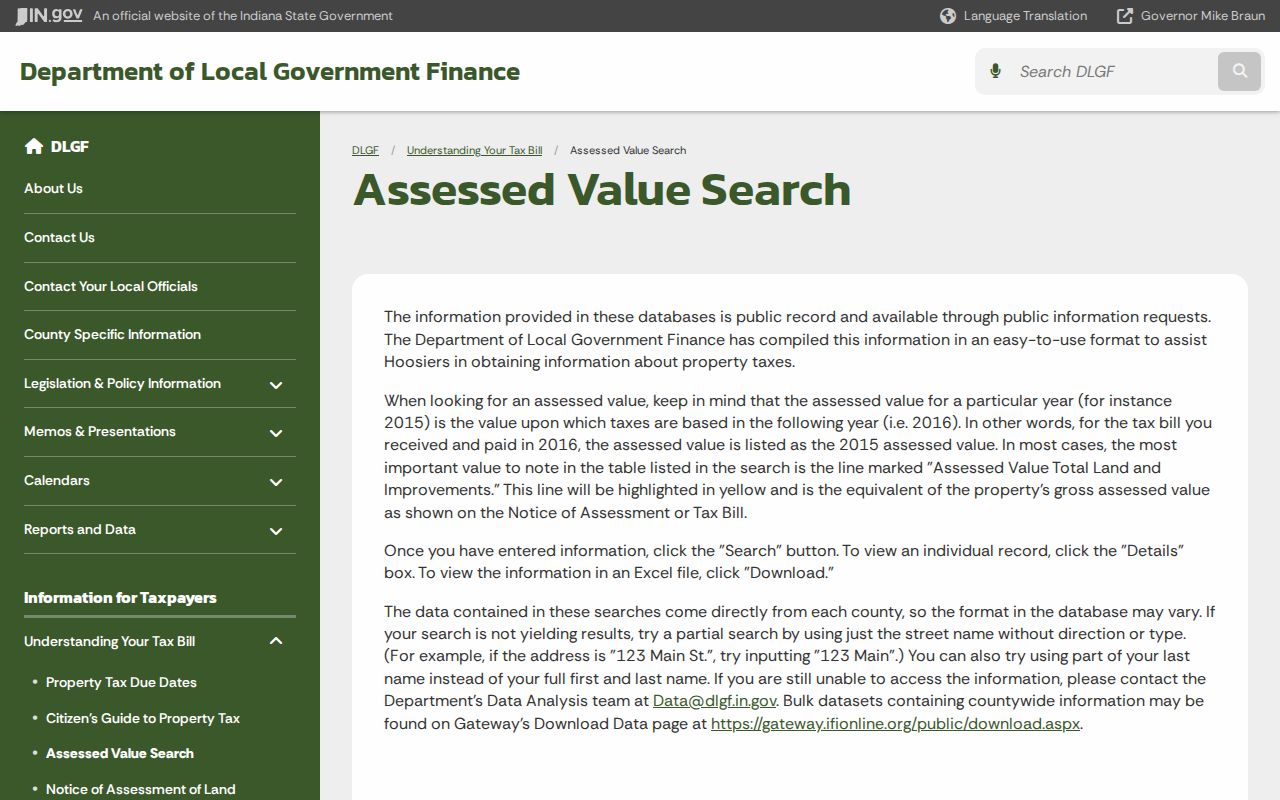
Formats vary by county, and an assessment year generally becomes payable the following year. Save both labels with any value used in an appeal or comparison. The Ohio County Assessor notes that property record cards are available through GIS. The Assessor also provides them at the office. Assessor Deede Brown's office sits at 413 Main Street. The office can resolve a missing card, a physical-characteristic error, or an assessment question. A statewide total is convenient. The local card carries the parcel detail needed to test land area, improvements, grade, condition, and other facts behind the value.
Ohio County 2026 Tax Calendar
Two dates anchor the 2026 tax calendar. The Ohio County Treasurer lists installments due May 11 and November 10, 2026. Treasurer Melinda Smith's office is at 413 Main Street, Room 110, in Rising Sun. Mail should go to PO Box 187. Call 812-438-2724 with payment questions. Listed hours run 8:30 a.m. to 4:15 p.m. on county open weekdays, though dates and hours can change, so confirm the county page before a late payment, payoff, or tax-sale inquiry.
Look Up an Ohio County Tax Bill
The Treasurer offers several ways to look up and pay a tax bill. PayGov supports lookup by name, parcel, or address. In-person payment, mail, a courthouse drop box, and payment with a coupon at Friendship State Bank's Rising Sun location round out the options.
- Search PayGov by parcel, address, or owner and confirm the parcel before paying.
- Read the installment, tax year, amount, and payment status.
- Compare deductions and assessed value with the Assessor and Auditor record.
- Ask the Treasurer about delinquency, tax-sale status, or a payoff that is not clear online.
- Assessed value
- The tax administration value assigned to land and improvements.
- Levy and rate
- The approved revenue and rate components applied through taxing districts.
- Homestead deduction
- Qualifying relief filed through the county Auditor.
- Tax lien
- The county's statutory claim tied to unpaid property taxes.
For the drop box, the county asks for an envelope, tax coupon, name, phone, and parcel number. Under the posted instructions, mail postmarked before the due date avoids late-fee treatment.
Ohio County Tax Deductions
Indiana separates deductions, which shrink assessed value, from credits, which shrink the tax itself. Applications normally go to the Ohio County Auditor. State forms cover several programs. These include homestead, over-65, disabled-veteran, blind or disabled, rehabilitated property, historic rehabilitation, heritage barn, and other programs. Most deductions carry over without annual refiling unless ownership, title, or use changes. Deadlines and eligibility should still be verified locally. Exemptions for qualifying charitable, educational, or religious uses follow IC 6-1.1-10 and -11. They generally require an application before April 1, subject to statutory exceptions. DLGF identifies Form 136, Form 120, and Form 136-CO/U among exemption forms.
A map that omits an exemption is not proof the Auditor denied one. Check the filed form, the county determination, and the bill. The same caution applies after a sale. Homestead or other relief tied to a prior owner's facts may not survive unchanged. Title or use changes can end that relief.
Ohio County Reassessment Timing
DLGF schedules a statewide four-year cyclical reassessment beginning July 1, 2026 for 2026 Pay 2027, with physical inspection of roughly one quarter of parcels each year. The Ohio County Assessor separately posts a 2030 general-reassessment notice. Both dates matter because they describe different parts of the value cycle. Annual trending uses prior-year sales to build market-condition adjustments. When comparing two tax records, preserve the inspection or notice date, physical characteristics, assessment year, payable year, and any changed deduction.
Ohio County Tax-Sale Records
A tax-sale advertisement is a dated procedural record, not a current ownership list. Ohio County's 2025 notice combined sale ID, APN, owner, minimum bid, address, and legal-description clues. It also warned that common street addresses and shorthand descriptions carried no warranty. For current status, obtain the current Treasurer or Auditor notice. Then follow the certificate, redemption, judgment or order, and any later tax deed. Do not carry the 2025 sale or redemption dates forward as 2026 advice.
The 2025 sample cited IC 6-1.1-24-1 et seq. It described bidder registration, sale certificates, and redemption. A sale entry does not make the bidder the immediate fee owner. Match the sale ID and APN to the full legal description. Then verify whether redemption occurred. Verify whether a later tax deed was recorded. Street-address errors or shorthand in an advertisement can misidentify the tract if used alone.
Reconcile Ohio County Tax Records
A solid parcel packet holds five pieces. Keep the GIS result, assessment card, tax bill, deduction record, and recorded deed separate from each other. Match them by APN and legal-description clues. A name or mailing address alone can mislead. Also save the date you pulled each item, because payment status, ownership display, and assessment data update on different schedules.
Discrepancies have simple first steps. If the Assessor card and the DLGF total differ, check the assessment year and whether one source reflects an update. A billed name that clashes with a recent deed may mean the tax roll has not finished its transfer update. Ask about that. Missing deductions go to the Auditor, with the filing and title facts in hand. The Treasurer handles payment posting, delinquency, installments, and payoffs.
For ownership and recorded liens, use the Recorder, since a tax record may name the taxpayer and show a balance yet prove nothing about deeds, mortgages, or easements. A paid bill, likewise, does not certify clear title.
Prepare Ohio County Appeal Evidence
Objective errors deserve direct proof. Measure the disputed building area yourself. Photograph condition problems. Mark every wrong characteristic on the card. For a value dispute, gather arm's-length sales with similar use, size, location, and valuation date, and explain your adjustments rather than submitting a list of unrelated prices.
DLGF splits appeals into subjective value questions and objective factual or legal issues, and that distinction shapes which tax years and remedies apply. Form 130 is state form 53958. File with the correct county office. Retain proof of delivery. Attend the informal meeting, and read the Assessor's recommendation before the PTABOA hearing.
Whether to pay during an appeal carries consequences no general rule settles for an individual parcel. Ask the Treasurer and Assessor how the pending appeal interacts with the current bill. Never assume filing delays collection. An installment schedule may not change either.
After a decision, compare the revised assessment with the next tax record and keep the determination. A factual correction can reach beyond the headline total. A deduction or credit issue follows its own county processing path. If the expected change never appears, give the responsible office the parcel number, decision date, assessment year, payable year, and a copy of the order. Labels matter here. The Assessor, Auditor, and Treasurer each keep a different piece of the tax process.
Evidence must match the valuation date and the property type. A later remodel, a distressed sale, or a parcel in another use class carries little weight without adjustment. Tie every photograph, measurement, sale, and comparable record to the exact characteristic or value issue stated on Form 130.
Appeal an Ohio County Assessment
Indiana Form 130 opens a real-property assessment appeal. Subjective claims contest the valuation itself. Objective claims cover the wrong owner of record, a missing deduction or credit, clerical error, a property-description error, or a legality question. Gather the property card, photographs, measurements, sale evidence, comparable parcels, and the notice before filing. The path runs from an informal meeting and Assessor review to the county Property Tax Assessment Board of Appeals, then the Indiana Board of Tax Review, and finally Tax Court. A tax-amount dispute is not an assessment dispute. Separate the two before you file.
Appeal window. State guidance commonly uses June 15 in the situations described by DLGF, but Ohio County's parcel-specific 2026 deadline was not posted. Confirm it with the Assessor before filing.
Find current appeal forms through the DLGF appeal resources.