
Trace Ohio County Former Owners Transfer by Transfer
No office keeps a ready-made roster of Ohio County former owners. The chain gets rebuilt transfer by transfer. Start with the newest confirmed deed and work backward. Carry the legal description, party names, date, and recording reference into each earlier search. The county Recorder links Doxpop for recent index and image access. Courthouse records and State Library microfilm carry the trail deep into the nineteenth century.
| Transfer Date | Grantor to Grantee | Deed Type | Book/Page or Instrument |
|---|---|---|---|
| Newest recorded transfer | Prior holder to present grantee | As indexed | Record exact reference |
| Earlier acquisition | Next prior holder to that grantor | As indexed | Repeat from acquisition deed |
| Pre-November 1997 step | Historic grantor to grantee | Read the deed book | Book and page from older index |
| 1844 starting era | First county-era parties found | Historic instrument | State Library or Recorder volume |
Every row in your chain should come from an actual instrument. A warranty deed, quitclaim, representative's deed, affidavit, or survivorship document moves title in its own way. Never infer a missing transfer just because two names seem to fit.
Ohio County's Online Window Starts in Late 1997
Per Doxpop's county coverage table, Ohio County's recorded-document index begins in November 1997. Scanned images follow in November 1999. That gap matters. A hit can appear in the index with no image attached. And a dead-end search before the cutoff proves nothing about whether a courthouse deed exists.
For this indexed period, the Recorder's linked Doxpop entry point serves as the online doorway.
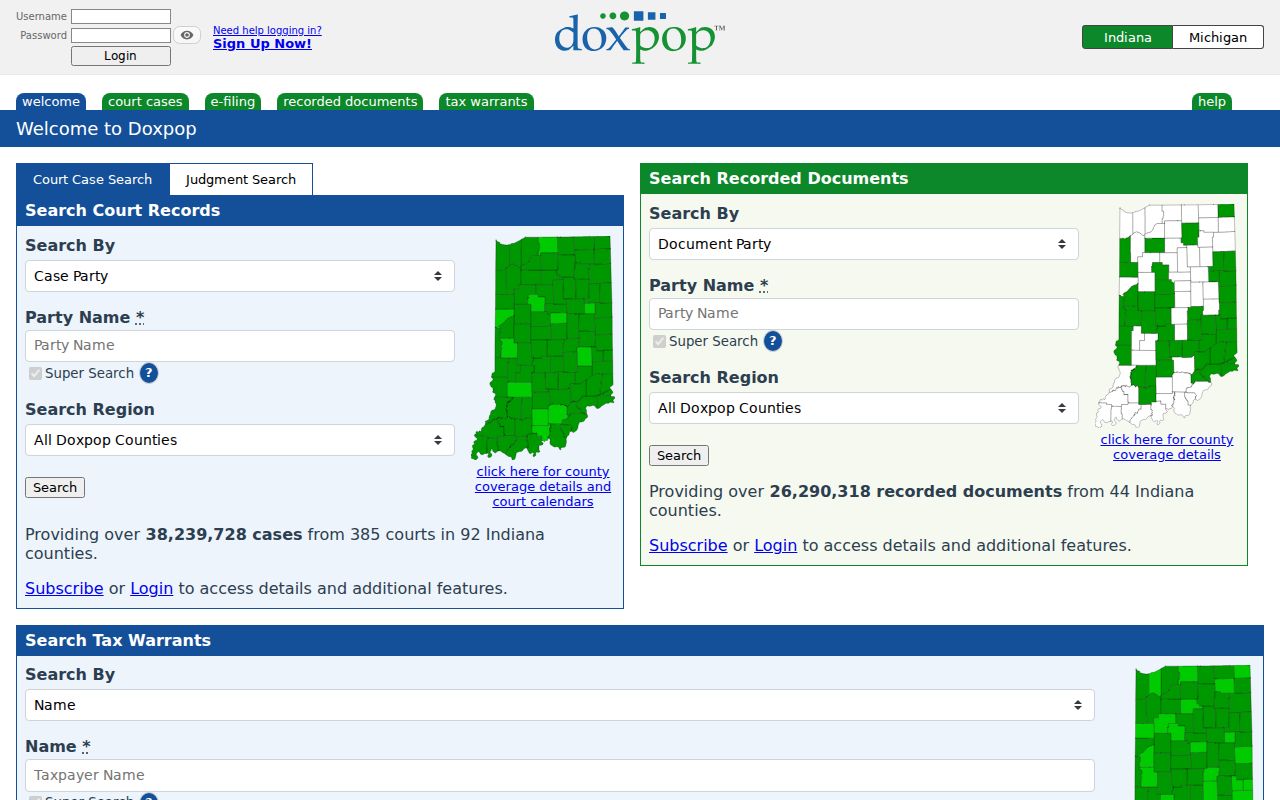
The Doxpop entry page does not display every live search control, so confirm the grantor and grantee field order within your current session before relying on results.
Know the cutoff. Use Doxpop for the indexed period, then move to Recorder indexes, deed books, and State Library microfilm for earlier former owners.
Casual, nonprofessional searching is described as free. Enhanced access and document images may carry charges. Confirm current copy terms with the Recorder, and never treat a preview as a certified record.
Reconstruct the Ohio County Deed Chain Backward
Think of each deed as a bridge between owners. The current parcel Card helps only for the address, APN, and displayed owner of record; the newest recorded deed marks the first reliable transfer. Search both grantor and grantee roles, because the same person appears on opposite sides of deeds at different dates.
- Capture the full APN, address, and legal description from the current parcel sources, then locate the newest deed naming the present grantee.
- Read the grantor, execution and recording dates, deed type, legal description, and document or book/page reference.
- Search that grantor as an earlier grantee. Test name variants, married names, initials, trust styles, estate names, and business suffixes.
- Repeat until the online index reaches November 1997, then continue in the correct reverse index and deed-book run.
- Grantor
- The party conveying the stated interest.
- Grantee
- The party receiving the stated interest.
- Chain of title
- The linked sequence of instruments affecting a parcel through time.
- Reverse index
- An index organized to find the other side of a grantor or grantee trail.
- Quitclaim and warranty deed
- Different conveyance forms whose exact promises must be read in the instrument, not guessed from an index label.
Ohio County Deed Books Reach Back to 1844
The Indiana State Library Ohio County guide opens with deed books A and B. These cover 1844 to 1847. Lettered runs continue through Y and Z, dated 1910 to 1915. Numbered books run through volumes 18 and 19 for 1976 to 1981. In all, the guide lists 28 land and deed microfilm items.
The index finding aids matter just as much. Volume 1 spans 1844 to 1870. Volumes 2 and 3 cover 1870 to 1923. Volumes 4 through 6 reach 1924 to 1980. Separate grantor and grantee Volumes 1 and 2 cover 1844 to 1899. These dates shape a request, but they promise neither legible frames nor full online coverage.
Note: Record the index volume, spelling, date span, deed book, page, and any unreadable frame before requesting further help.
The 1844 County Line Is a Historical Research Clue
Ohio County was organized from Dearborn County in 1844. That date matches the first deed-book runs and gives former-owner research a natural checkpoint. When a trail nears county formation, the predecessor county may hold earlier records, or the first Ohio County entry may explain where the land came from. Assume nothing about a property having no prior history.
The courthouse dates to 1845. Indiana heritage material calls it the state's oldest continuously used courthouse. That continuity is welcome context, yet it never replaces a volume and page reference.
Platted Additions Keep Prior Owners Tied to the Same Land
Street names and mailing addresses change far more easily than legal descriptions. Ohio County's 2025 tax-sale material names Brown Addition lots 63 through 68. It also names James Addition lots F, G, and H in a subdivision of lot 13. Vocabulary like this can tie an older deed to a present parcel. It helps when the address no longer matches.
Use the shorthand only to locate the recorded plat through the Ohio County Recorder. Compare plat name, lot, roads, replat references, and dedication language against the deed and GIS parcel. A sale notice warns that street and common descriptions carry no warranty. So the APN and recorded description deserve priority.
Estate Records Can Explain a Broken Ohio County Owner Chain
A deceased owner of record may vanish from an ordinary deed search. The transfer could have run through probate. It might have used a personal representative, a survivorship affidavit, a trust, or a transfer-on-death instrument. Search the estate and representative names in MyCase for a lead. Then return to the Recorder for the instrument actually recorded.
A will or inventory can mention real estate without proving any later conveyance occurred. Record the case number. Note the sale order or representative authority. Add the parcel description and the final deed or affidavit. Collect only what solves the parcel trail. Leave unrelated personal details out of your notes.
Request Ohio County Ownership History Offline
The Recorder at 413 Main Street in Rising Sun still handles the old-fashioned courthouse inquiry. Bring the parcel number. Bring the full legal description if you have it, current and prior owner names, the addition with lot and block, and a date span. Say upfront whether you want to inspect records or need a specific copy. Single-copy mechanics are covered on the Ohio County deed records page.
Microfilm research points to Indianapolis. The Indiana State Archives reading room sits at 6440 East 30th Street. It is reachable at arc@iara.in.gov or 317-591-5222. Vault film may need scanning or duplication, and copying fees can apply. When a portal image is missing, these in-person, phone, email, mail, library, and archive routes carry the search.
How Far Ohio County Prior-Owner Records Can Go
Ohio County deed books and indexes document ownership back to the county's 1844 founding. Whether any single chain actually reaches that far is another matter. Legibility matters. So do correct names, parcel-description continuity, and the survival of linked instruments. Doxpop's 1997 index start marks only where remote coverage ends, not where Ohio County ownership records begin.
Use history with care. Research former owners for title, estate, purchase, and house-history purposes. Never use a living person's record trail to target, harass, or defeat protected-address safeguards.
Indiana's Access to Public Records Act, IC 5-14-3, makes public records generally available. Another law, rule, or court rule can say otherwise. A custodian can still withhold protected details while allowing inspection of the instrument itself. Keep a research log for every backward step. Record the grantor and grantee spellings, instrument type, and date of recording. Include the book and page or instrument number, the legal description, and the source consulted. That log catches a skipped index interval, an estate transfer, or a name variation. It can stop such gaps before they become a false link in the Ohio County ownership chain.