
Ohio County Deed Types
The Ohio County Recorder preserves every instrument accepted for recording, whatever its type. A deed's label only signals its form; the full text, legal description, signatures, exceptions, and cross-references decide what the document actually does.
| Deed Type | What It Does | Common Use |
|---|---|---|
| Warranty deed | Conveys title with stated covenants | Common purchase transfer |
| Quitclaim deed | Conveys whatever interest the grantor holds | Interest release or correction |
| Personal representative's deed | Transfers under estate authority | Probate administration |
| Sheriff's deed | Records a transfer after court process | Completed foreclosure |
| Tax deed | Follows the statutory tax-sale process | Completed delinquent-tax transfer |
Recording puts the world on notice. It does not guarantee the grantor held every interest claimed. Mortgages, liens, and easements burden land rather than convey ownership, yet each one still belongs in a chain review.
Ohio County Recorder Access
Recorder Vickie Monroe's office sits at 413 Main Street, Rising Sun, Indiana 47040-1030. Call 812-438-3369 for inspection, copy, historic-index, or legal-description questions. Email works too, at ohiocorecorder@ohiocounty.in.gov. The county page posts the current fee schedule and electronic recording details. When an online image is missing, the office counter is the main fallback. A focused mail, email, or Indiana Access to Public Records Act request should identify party names, approximate date, document type, instrument number, and property description.
Ohio County Doxpop Window
Doxpop indexes Ohio County recorded documents from November 1997. Scanned images begin in November 1999. Early hits may lack a web image. Search each party as grantor and as grantee. Test initials, married names, trusts, estates, and exact entity suffixes. The vendor's live search controls can change, so expect the field layout to vary.
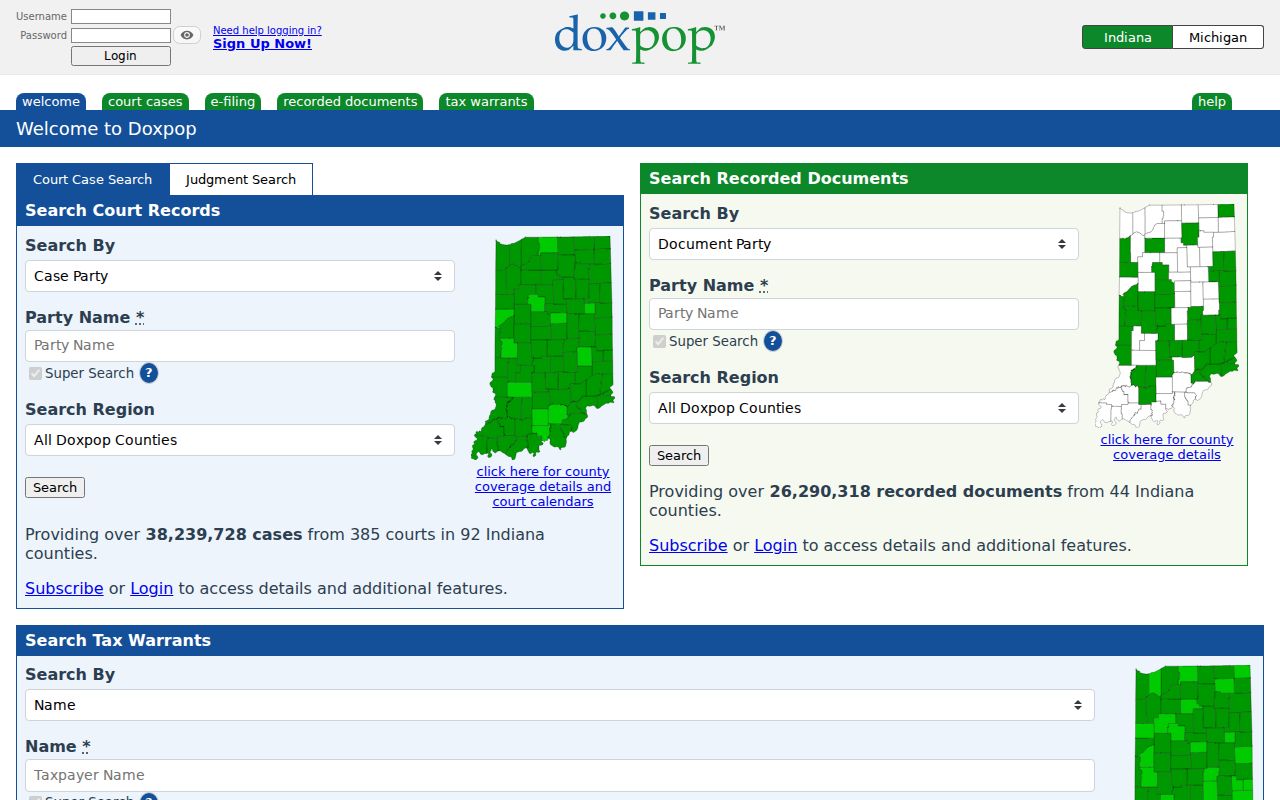
Free nonprofessional searching is available. A 2025 vendor update notes that previews may be obscured and prices copies at $2 per page plus card fees, so confirm the current amount before ordering.
Ohio County Deeds Since 1844
The Indiana State Library microfilm guide reaches back to the county's founding in 1844. Grantor and grantee volumes span 1844 through 1899. Later deed indexes extend the paper trail to 1980. For deeds recorded between 1981 and 1996, turn to the Recorder. Do not assume the title chain simply breaks. Ohio County was carved from Dearborn County. That matters for early land research. The oldest transactions may sit in the predecessor county's deed records instead. Wherever you search, note the index volume and the exact name spelling. Also note the date span, the book and page.
The State Library's finding aid lists 28 land and deed items through 1981. That is a manageable body of material for a systematic deed search. The 1845 courthouse is described by Indiana heritage sources. It is the state's oldest continuously used courthouse. That makes the local Recorder's office a working custodian of current deed records. It is also the first stop for archival work.
Remote researchers can ask staff to identify a specific index entry or copy a cited page. For deeper digging, cite the film call numbers directly. A broad request for everything tied to one surname rarely works as well.
Online cutoff: Doxpop starts in November 1997. Older Ohio County deed records require courthouse, deed-book, or microfilm research.
Ohio County Grantor-Grantee Chain
A grantor conveys an interest. A grantee receives it. Start with the newest reliable deed, note its grantor, then locate the instrument by which that grantor acquired the same land.
- Find the newest transfer and confirm its grantee, date, and full property description.
- Record the grantor and every prior-deed citation in that document.
- Search that grantor as an earlier grantee, testing all useful name forms.
- Repeat backward and move to deed books when the online index ends.
- Grantor
- The party conveying the stated interest.
- Grantee
- The party receiving the stated interest.
- Chain of title
- The linked sequence of instruments affecting ownership.
- Book/page or instrument number
- The Recorder reference used to retrieve a document.
Brown Addition lots 63 through 68 and James Addition lots F, G, and H all appear in a 2025 tax-sale notice. Plat names like these narrow a parcel fast. They help when street references or owner names alone fall short.
Ohio County Plats and Easements
Plats explain lots, additions, streets, and adjoining tracts. Search the Recorder by subdivision or addition name. You can also search by lot, by cabinet and slide, and by the parties named in connected deeds. A GIS map can locate a candidate parcel. Its lines are not the recorded plat or a survey. Easements and releases demand cross-reference review. Indiana recorder guidance says a release should identify the original easement. It should also reflect the current owner on county tax records. A path visible on an aerial image proves no recorded right. A survey-cabinet reference can matter as much as a deed-book citation. One 2025 tax-sale sample described land through survey plat Cabinet 3, Slide 154-B. It also cited quarter-section acreage. Another cited Brown Addition lots and Liberty Court. That mixed vocabulary runs throughout Ohio County deed records. Retrieve the actual plat or survey before stating a boundary. Then compare its recording date against later splits, combinations, or corrective instruments.
Ohio County Deeds and Liens
The Ohio County Recorder's mechanics-lien intent form is a filing aid. It does not prove a lien exists. Save the claimant and the owner. Record the amount where relevant, the date and number, the property description, and every release, satisfaction, foreclosure, or court filing.
A blank online result proves little. Coverage gaps, name variants, older indexes, and unrecorded interests all limit that conclusion. Compare mortgages, assignments, releases, tax-sale instruments, plats, and deeds affecting the same legal description.
Probate can break a clean buyer-to-seller line. Search the decedent, the estate, the personal representative, the trust, and the later grantee. Match the deed to the Clerk's estate file. A will alone is not enough. It names intended recipients but cannot prove how the land moved, so a representative's deed, survivorship affidavit, transfer-on-death instrument, or recorded court order supplies the link the chain needs.
Document an Ohio County Deed Chain
Give every transfer its own row. List the recording date and the deed type. Add the grantor, the grantee, the instrument or book/page reference, the APN, the full legal description, and a prior-deed citation. Note mortgages, releases, easements, liens, plats, and court orders recorded between transfers, keeping a missing period visible instead of buried in a narrative.
Name searching takes the same care. Test the surname first. Then try a given name or initials. Also test married and former names, estate captions, trustee names, corporate suffixes, and assumed business names. A current grantee may appear as a grantor elsewhere, so run both index directions. When two people share a name, separate them with the land description, a spouse or co-owner, the document date, and the prior reference.
Count the image pages. Note any missing exhibit, unreadable scan, or truncated portal display. An index entry proves only that an entry appears. The full image reveals reservations, exceptions, subject-to clauses, signature capacity, and attached descriptions.
Ohio County Court-to-Deed Links
Court cases often explain a later deed. Foreclosure, quiet-title, partition, and probate files can sit behind one transfer. Search MyCase by party or business name and date. The Ohio County Clerk can supply the full file. Capture the cause number. Record the judgment or sale order, the legal description, and the instrument filed afterward.
A docket entry is not a conveyance. The final Recorder instrument must match the property the court described. Tax sales need their own trail. Follow the advertisement through the certificate, the redemption record, and any tax deed. For a mortgage foreclosure, link the mortgage and its assignments to the judgment, the sheriff's sale, the sheriff's deed, and any later release, all on the same tract.
The Clerk sits at the courthouse, 413 Main Street, Room 207, in Rising Sun. Ohio Circuit Court serves two counties. It covers Ohio and Dearborn, so read the court selection closely. MyCase can omit older, sealed, confidential, or protected material, and the Clerk holds the actual file. Request a certified order when exact language matters, then verify that it or a resulting deed was recorded.
Quiet-title and partition matters need extra care. Capture every named interest, service or notice fact, judgment term, appraisal or sale order, and final distribution, then compare the court description with the deed recorded after judgment. A name match is not enough. A different lot, acreage, or section reference breaks it.
Order an Ohio County Deed
An online preview screens a result. A full image is still needed for the complete legal description. It also carries signatures, exhibits, exceptions, and acknowledgments. Order online if that option exists. Or give the Recorder the instrument number or book/page, the party names, the type, and the recording date.
In-person inspection is the clearest fallback. Doxpop's bulk-sales table lists Ohio County image sales at $0.20 per page. The price is subject to a current quote. That bulk service is not the same as a certified county copy.
Recorded, not guaranteed. Ohio County deed records show accepted instruments, not a title opinion. Unrecorded, misindexed, or disputed interests can still exist.
Ask for certification when the receiving court, agency, or transaction requires it. Keep the certification and every exhibit with the deed.