
Compare Ohio County Value Types
Ohio County value records answer different questions. Indiana assesses real property at 100 percent of market value-in-use, a DLGF term for how a property functions in its current setting. The statewide standard still does not promise an assessment will equal a later sale price.
| Value type | Meaning | Official record |
|---|---|---|
| Gross assessed value | Total land and improvements used on Form 11 and the tax bill | Assessor card and DLGF search |
| Market value-in-use | Indiana's assessment standard for the property's current use | Assessment methodology and county record |
| Sale price | Consideration reported for a dated transfer | Sales Disclosure and recorded deed |
| Private appraisal | An opinion developed for a stated date and purpose | Not a county public-record value |
Land and improvement components show how the gross total is built. Deductions, credits, and exemptions shape tax treatment, not the meaning of a sale price. Those calculations belong in the Ohio County property tax records workflow.
Ohio County Assessment Fields
The DLGF Assessed Value Search labels "Assessed Value Total Land and Improvements" as the gross amount on Form 11. The same figure appears on the tax bill. It draws on county data. Search, Details, and Download paths are all offered. Partial street or owner text often works better than a fully formatted entry.
The statewide tool publishes no individual parcel result for Ohio County here. A solid record of any lookup should include the assessment year, land amount, improvement amount, and total. It should also capture parcel and owner identifiers and any update label. County formats vary.
Use the Indiana Value Search for Ohio County
The state's official assessed-value guidance provides the public route to county-supplied totals.
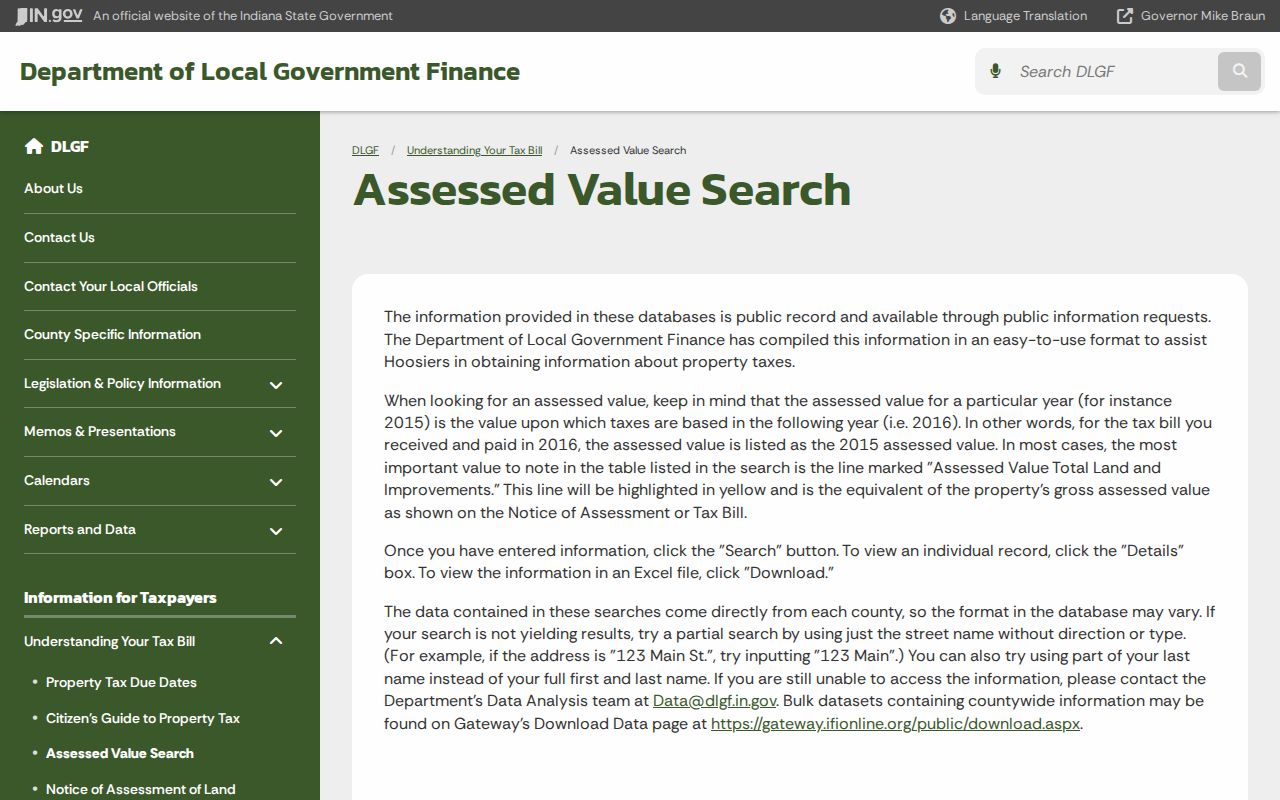
The guidance page leads into the live database. Its controls can change, so keep the assessment year with every downloaded or transcribed total.
Sometimes the application is unavailable. Then request the property record card from the Ohio County Assessor at 413 Main Street, Rising Sun. You can also call 812-438-3264. That card is the better place to compare land, improvements, and physical characteristics. It will also show any local update. Statewide search access does not remove the in-person and telephone channels.
Annual Ohio County Value Changes
Indiana applies annual trending with prior-year sales to develop market-condition adjustments. DLGF's published example uses 2024 sales to develop 2025 assessment, payable in 2026. The example explains timing only. It is not a value for any Ohio County parcel.
A year-to-year increase can reflect trend factors or new construction. It can also reflect a correction, a change in use, or a reassessment. Compare card fields, not totals alone. The card may not make the change clear. Ask the Ohio County Assessor which event produced it.
Ohio County Reassessment Timing
Statewide cyclical reassessment begins July 1, 2026 for 2026 Pay 2027. It runs over four years. About one quarter of parcels get a physical review each year. The county Assessor page separately posts a 2030 general-reassessment notice. These are related but distinct notices.
No parcel-by-parcel Ohio County cycle schedule is published. Preserve the assessment year and the date a card was obtained. A later physical inspection or annual adjustment can change the record without a sale.
Note: A statewide cycle date does not reveal when one Ohio County parcel will be inspected. It also does not reveal when its value will change.
Find an Ohio County Property Value
Start by resolving the address to a parcel in Ohio County Think GIS. The map result can expose an APN and a Card control. The Assessor office provides the card when it is not visible online.
- Search the property address, owner, or parcel ID and confirm the APN.
- Open the property card and record the assessment year, land, improvements, and total.
- Use the current Sales Disclosure search for a dated transaction; use the retired search for 2008 through 2020.
- Compare dates and parcel identifiers before interpreting a difference.
- Assessed value
- The official value recorded for assessment.
- Market value-in-use
- Indiana's standard based on the property's current use.
- Assessment ratio
- Assessed value divided by sale price in DLGF analysis.
- Consideration
- The transaction amount reported in a deed or disclosure.
- Reassessment
- A review that may update parcel characteristics and value.
Ohio County Sale Price Records
The current Sales Disclosure application and the retired 2008 through 2020 application are the state sources for reported transfers. A disclosure date and price describe that transaction alone. They do not establish today's property value. Shifts come from improvements, damage, a non-arm's-length transfer, or market change.
The newest deed can confirm the parties and legal description. Keep the disclosure and deed tied by parcel and date. Do not treat a tax-sale minimum bid as a sale price. The 2025 Ohio County advertisement is a notice, not proof that a listed parcel sold.
Land and Improvements in Ohio County
Separating land from improvements helps explain a change. A new structure may raise improvements while the land component stays similar. A land trend can move even when no building work took place. Physical fields on the property card help test those possibilities.
GIS aerials can suggest a building or road changed. Image date is not a construction date, though. Confirm building details with the Assessor. For incorporated Rising Sun parcels, also check the city planning and permit records.
Keep Ohio County Value Dates in the Same Timeline
Assessment year, tax-pay year, deed date, sales-disclosure date, and appraisal date are distinct markers. Each one marks a different moment. In Indiana, assessment-year data is generally payable the following year. So a sale recorded after the valuation date can be entirely real. Yet it may have no bearing on that assessment's evidence.
Build a short timeline before comparing anything. Start with the assessment date and year. Then add the transfer date and the disclosed consideration. Include any physical change and the date each portal was checked. A tax-sale amount belongs in its own lane. Label it only as the minimum bid from that notice. It is not an appraisal. It is not proof a sale closed.
If a shift is hard to explain, ask the Assessor about the cause. Annual trending may have touched the card. A physical inspection, new construction, a use change, or a correction may have touched it too. A total alone will not reveal the reason. Keep the county's 2030 notice and the statewide four-year cycle labeled separately too.
Exemptions and deductions deserve their own column. They can move a taxable result while leaving the gross land-and-improvements figure untouched. Indiana exemption rules carry distinct forms and deadlines. A blank GIS layer does not prove an application was denied or never filed. Ask the Auditor or Assessor for parcel-specific status.
A purchase decision may hinge on present worth. In that case, treat the assessment and disclosure records as inputs rather than a conclusion. Condition, private improvements, easements, flood issues, and transaction terms may not be resolved by public figures. Preserve the meaning of each number. Rely on a qualified appraisal whenever a current market-value opinion is truly required.
Limits of Ohio County Assessed Value
An assessed value is not a guaranteed sale amount, an offer, a title opinion, or a parcel survey. It is not equity either, since the assessment record does not subtract loans or other private obligations. Every value must carry its assessment year.
Value versus price. Ohio County assessed value supports taxation and is not what a buyer must pay. Use a qualified appraisal when a current market opinion is required.
Ask the Assessor when a card looks wrong. Learn which field can be corrected and what proof the office requires. Then preserve the response, the record date, and the assessment year so later comparisons still mean something.
Label Every Ohio County Value Source
A good comparison sheet names the source beside every figure. List the Assessor's land, improvement, and total assessment. Also list the assessment and pay years, the disclosure price and transfer date, and any private appraisal with its effective date. Never average unlike figures. Their differences are often the point. Each was created for a different administrative or market purpose.
Recheck the local card before trusting an older download. County-provided values can be corrected or updated after a saved result was produced.